
By San Thai Shin
Across the world, young people are rising in protest against injustice, inequality, and corruption. While every country has its own political and economic realities, a common pattern has emerged a generation frustrated by exclusion, economic hardship, and leaders who appear disconnected from the suffering of ordinary citizens. The growing wave of Gen-Z protests demonstrates that youth unrest is no longer isolated within national borders but has become a global phenomenon tied together by shared grievances.
One of the major forces driving youth protests is economic insecurity. Young people are often the first to suffer when economies stagnate. Chronic unemployment, limited opportunities, and the collapse of hopes for upward mobility leave many feeling trapped despite years of education and sacrifice. This frustration was evident during the 2010 uprising in Tunisia, where economic hardship, repression, and government abuses pushed young people into the streets after the self-immolation of street vendor Mohamed Bouazizi. His death became the spark that ignited the Arab Spring, a movement that reshaped political conversations across the Middle East and beyond.
In many countries today, similar conditions continue to burden younger generations. Nations experiencing strong Gen-Z mobilization often face weak economies, high youth unemployment, and widening inequality. Yet economic hardship alone does not fully explain the intensity of today’s protests. The strongest unifying force behind many Gen-Z movements is anger toward corruption. Across continents, young people are expressing outrage at political elites who continue to enjoy wealth, privilege, and impunity while ordinary citizens struggle with poverty, insecurity, and failing public services.
In Nepal, viral images of wealthy “nepo kids” displaying luxury lifestyles fueled public anger over inequality and privilege. In Indonesia, protests erupted after revelations that parliamentarians were receiving housing allowances many times larger than the country’s minimum wage. In Serbia, the collapse of the Novi Sad railway station in 2024, which killed more than a dozen people, became a symbol of government negligence and corruption. Protesters argued that corruption and poor oversight had turned public infrastructure into a deadly hazard.
Elsewhere, in Peru, demonstrators demanded justice for widespread criminal extortion and violence that many believe is enabled by government complicity with organized crime. In the Philippines, outrage intensified after a government report revealed that more than two billion US dollars intended for flood-relief projects had disappeared through corruption. In each of these cases, the message from young people has been clear: governments that prioritize elite privilege over public welfare are losing legitimacy in the eyes of a new generation.
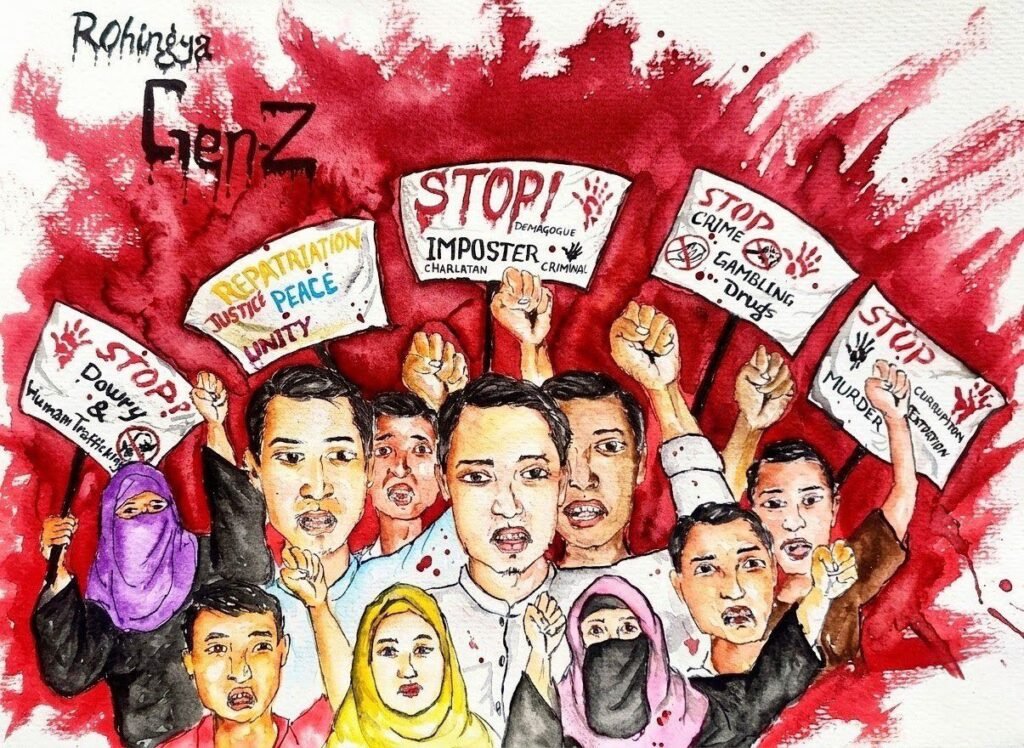
The Rohingya people today expressed many of these same global grievances, but in an even harsher reality. While youth movements in many countries are protesting corruption and exclusion, the Rohingya people remain trapped in statelessness, homelessness, hopelessness, and an uncertain future. For decades, they have been denied citizenship rights, national identity, and even full refugee protections. Entire generations have grown up without belonging to any recognized state while surviving persecution, forced displacement, and genocide.
Within this suffering, many Rohingya youth feel abandoned by both political systems and humanitarian structures. They see false leadership, manipulation, and individuals accused of collaborating with oppressive forces continuing to hold influence over refugee communities. Similar to the anger directed at privileged elites and “nepo kids” elsewhere, frustration has emerged among Rohingya youth toward figures accused of benefiting from the suffering of their own people.
Similarly the Rohingya people eyewitness and testified that Dil Mohammed was connected to the genocidal Myanmar military and of forcefully conscripting Rohingya youth into the military against the Mogh rebel (AA). Today, many young Rohingya question how an individual accused of contributing to the suffering of refugees is still attempting to govern Rohingya refugee in Bangladesh. To many young people, this reflects the same global pattern of unaccountable leadership and abuse of power seen in other countries.
At the same time, Rohingya youth also question inequalities within the humanitarian response system. Similar to the outrage in Indonesia over excessive political privileges, many refugees express frustration that Rohingya families survive on food assistance only 7 to 10 dollars per person while many foreign humanitarian staff receive salaries ranging from five to seven thousand dollars per month, alongside transportation, housing, insurance, and food allowances. These disparities have deepened perceptions that humanitarian systems are disconnected from the daily realities of refugee life.
Security failures inside the camps have further intensified frustrations. Similar to protests in Peru against criminal violence and state failure, many Rohingya refugees continue to face kidnapping, human trafficking, extortion, and insecurity inside the camps while camp authorities are often viewed as unable or unwilling to provide effective protection. Several Rohingya refugee leaders and activists have reportedly faced threats and violence without adequate UN protection mechanisms. In addition, repeated fire incidents — nearly two thousand in nine years — have raised criticism toward camp management systems and agencies accused of failing to take strong enough preventive measures.
In response to all of these realities, Rohingya Gen-Z initiated a peaceful digital movement in 2026. Inspired by the growing global wave of youth resistance, young Rohingya activists began using social media, digital campaigns, statements, and discussions to speak against corruption, injustice, statelessness, and the ongoing suffering of their people. Yet despite their peaceful activism, many young Rohingya feel ignored by governments, humanitarian institutions, and international organizations. Rather than engaging with their concerns, some activists believe that organized violence and criminal incidents are sometimes manipulated to discredit or blame Rohingya Gen-Z movements.
Still, the momentum of the movement continues to grow. The Rohingya Gen-Z movement is not rising to govern refugee camps or seek power within displacement. Rather, it is demanding accountability, dignity, justice, and the right to return safely to their homeland of Arakan. It represents a generation refusing to accept permanent exile, silence, and hopelessness.
The global spread of youth movements reflects how interconnected the modern world has become. The anticorruption wave of 2025 first gained momentum in Asia, with movements in Indonesia, the Philippines, and Nepal drawing inspiration from earlier uprisings in Sri Lanka and Bangladesh. Through social media and digital communication, protest strategies, symbols, and messages now travel across borders almost instantly.
One striking example is the global use of imagery from the Japanese manga One Piece. Gen-Z protesters from Madagascar to Peru have adopted variations of the Straw Hat pirates’ flag as a symbol of resistance against corrupt rulers and the liberation of ordinary people from oppression. This creative use of popular culture demonstrates how today’s youth movements are building a shared international identity rooted in resistance against corruption and injustice.
The Rohingya Gen-Z movement is now becoming part of this broader global awakening. It is the voice of a generation born into displacement yet refusing to remain invisible. It is the voice of young people demanding not only survival, but dignity, justice, recognition, and a future.
Ultimately, the rise of Gen-Z protests reveals a deeper crisis of governance worldwide. Young people are not only demanding jobs or economic reforms; they are demanding accountability, inclusion, and human dignity. They are challenging systems where corruption enriches a small elite while leaving the majority behind. As global interconnectivity continues to strengthen through the internet and social media, these movements are likely to inspire one another even further.
The message echoing from streets, campuses, refugee camps, and digital spaces across the world is unmistakable: greed, corruption, and injustice are no longer local grievances. They have become global grievances, and a generation is refusing to remain silent.
One of the major forces driving youth protests globally is economic insecurity but the Rohingya gen-Z is raising voice to resolve the endless cycle of displacement and exploitation. Young people are often the first victims of stagnant economies, unemployment, leadership and shrinking opportunities. Their dreams of education, safety, and upward mobility are crushed by systems that reward privilege instead of merit. This frustration was visible during the 2010 uprising in Tunisia, where economic hardship, repression, and government abuses pushed youth into the streets after the self-immolation of Mohamed Bouazizi, sparking the Arab Spring. Yet the Rohingya can’t speak to have a university level education opportunity and keep them mouth plug.
Today, similar youth frustrations continue across many countries. Nations experiencing strong Gen-Z mobilization often struggle with weak economies, high youth unemployment, and political systems dominated by aging elites. In Nepal and Morocco, youth unemployment remains critically high, while the COVID-19 pandemic deepened poverty and uncertainty for millions of young people worldwide.
Yet beyond economic hardship, the strongest rallying cry of today’s youth movements is corruption and false leadership. Across continents, young people are furious with political elites who enjoy wealth, privilege, and impunity while ordinary citizens suffer insecurity, violence, and hopelessness.
In Nepal, outrage erupted over viral images of wealthy “nepo kids” flaunting luxury lifestyles amid widespread hardship. In Indonesia, protests intensified after revelations that parliamentarians were receiving housing allowances many times higher than the minimum wage. In Serbia, the collapse of the Novi Sad railway station in 2024, which killed more than a dozen people, became a symbol of corruption and negligence. In Peru, demonstrators protested against criminal extortion and violence enabled by state complicity with organized crime. In the Philippines, public anger grew after reports revealed that billions of dollars intended for flood-relief projects had disappeared through corruption.
The Rohingya experience reflects these same global grievances, but in an even more painful form. Unlike many other oppressed communities, the Rohingya are not only suffering from corruption and exclusion; they are trapped in statelessness, homelessness, hopelessness, and an uncertain future. For decades, the Rohingya people have been denied citizenship rights, national rights, and even full refugee rights. Generations have grown up without belonging to any recognized state, while surviving persecution, displacement, and genocide.
At the same time, many Rohingya youth feel abandoned by both political structures and humanitarian systems. They see false leadership, manipulation, and individuals accused of collaborating with oppressive forces continuing to hold influence over refugee communities. Similar to the anger directed at “nepo kids” and corrupt elites elsewhere, frustration has emerged against figures such as Dil Mohammed, who many Rohingya activists accuse of being connected to the genocidal Myanmar military and of forcing Rohingya youth into military conscription to fight against the Arakan Army (AA). Today, many young Rohingya question how individuals accused of such actions are still attempting to influence or govern refugee communities in Bangladesh.
The anger also extends toward humanitarian inequality and failures in UN protection mechanism. While refugees survive on extremely limited monthly food assistance only 7 to 10 dollars per person — many foreign humanitarian staff receive salaries ranging from thousands of dollars per month alongside transportation, housing, insurance, and food allowances. Many Rohingya youth question how such enormous disparities can exist while refugees continue to live in extreme vulnerability and insecurity.
There is also deep frustration over the failure to ensure protection inside the camps. Several Rohingya refugee leaders and activists have reportedly faced threats, violence, or insecurity without adequate protection mechanisms. Kidnapping and human trafficking networks continue to target vulnerable Rohingya families, while many believe that camp authorities have failed to provide sufficient security or accountability. Repeated fire incidents in the camps — numbering nearly two thousand over the years — have further intensified criticism toward camp management systems and humanitarian agencies that refugees feel have not taken strong enough preventive action.
In 2026, Rohingya Gen-Z initiated a peaceful digital movement to raise awareness about these issues and advocate for justice, accountability, dignity, and the right to return home. Through social media campaigns, statements, discussions, and digital activism, young Rohingya voices began calling attention to the realities facing their community. Yet many activists feel ignored by governments, international institutions, and humanitarian organizations. Instead of meaningful engagement, some young people believe that intentional violence, misinformation, and criminal incidents are sometimes used to discredit or blame Rohingya Gen-Z activism.
Despite these challenges, the movement continues to grow. The Rohingya Gen-Z movement is not calling to govern refugee camps or seek power within displacement. Rather, it is demanding change, accountability, dignity, and ultimately the right to safely return to their homeland of Arakan. The movement reflects a generation that refuses to accept permanent exile, statelessness, or silence.
Like Gen-Z movements across the world, Rohingya youth are speaking against corruption, inequality, abuse of power, and systems that prioritize elite interests over human dignity. Their struggle is deeply connected to the broader global wave of youth resistance. Through social media and global interconnectedness, today’s generation increasingly recognizes that corruption and injustice are not isolated national problems but shared global grievances.
The message rising from Rohingya Gen-Z is clear: a people denied citizenship, protection, and justice for generations are no longer willing to remain invisible. Their movement is not merely about protest; it is about survival, dignity, accountability, and the dream of returning home to Arakan with rights, recognition, and freedom.